Back in February of 2019, just before the Super Bowl, a big snowstorm descended on the Sierra Nevada and blanketed everything in white. Our snowboard enthusiast nephews and nieces descended too, spilling into spare rooms everywhere in the house, two even flew in from Virginia having heard the news of the big winter blast.
“Meteorologists are calling this the Storm of the Century,” our nephew gushed, smiling and excited as a kid on Christmas morning, hardly able to wait to take his snowboard to the mountain.
“Well, look, it’s only two-thousand nineteen. Isn’t that a little early to be dubbing this the Storm of the Century?” I said to him, maybe thinking I’d calm him down a bit.
“No. This is it. It’s coming now. The Storm of the Century!”
And indeed it was quite a storm. It took me two full days to dig the Subaru out of the garage.
Now it’s late January 2021 and meteorologists, reporting out of Reno, Nevada, are proclaiming this storm the real deal, with snowfall totals in the high mountains literally off their charts, and about 10% more snowfall totals than the 2019 storm. What can I say? Be careful before you indulge in hyperbole. And be careful before you believe it as it seems to be everywhere.
 On Wednesday, the weatherman called the storm a blizzard, though I’m not sure it met the criteria: sustained winds above 35 mph, blowing snow and visibility a quarter mile or less, but of course Andrea and I went walking in it. Visibility was poor, close to white-out conditions at times. But all criteria for ‘Blizzard’ met for 3 hour or more? Perhaps an exaggeration.
The roads were not plowed but were walkable. The fields just off the roads much less so. There I am walking easily enough and in the next moment waist deep in snow.
I think of Jack London and his wonderful short story, To Build a Fire. Maybe his best, would you agree? Did he take a walk like this one in bitter cold and imagine how it might be to try to make it 10 miles to the next village only to be stranded in cold and try to build a fire with fingers so cold he could not hold a match, and then try striking matches by holding them between clenched teeth? Remember? Or if not, dig out that story by a fireside and be reminded.
Or maybe the cold, with wind whipped clouds of snow so hard and pounding, makes you think of Robert Service, Whitehorse bank teller turned Yukon goldrush poet and his ironic and twisted, Cremation of Sam Mcgee. Ah, burning there in a stove the corpse proclaims, “Please close that door…Since I left Plumtree, down in Tennessee, it’s the first time I’ve been warm.”


My hands are painfully cold on this walk, no more than a mile or two from home. Can I get frostbite on so short a walk? Perhaps not. Home is only a short distance away, and surely the fire I started in the woodstove this morning will still be cheery and bright, the living room warm. We say hello to neighbors, those few who are braving the storm, and head for home.
Thursday morning, the snow was still falling, and in fact would fall all day and night and into Friday morning, but walking that morning was much more pleasant. I dig out a book of poems, surely someone, perhaps Emily Dickinson or Ralph Waldo Emerson has written of a morning like this one: there’s a promise of sunlight, clouds are heavy but here and there are breaking, and the wind is not so cold. But no one has yet shown you a morning such as this.
More than a million of you visited this site in 2020. I know perhaps a few hundred of you. What were you searching for? Is there something I can give you?

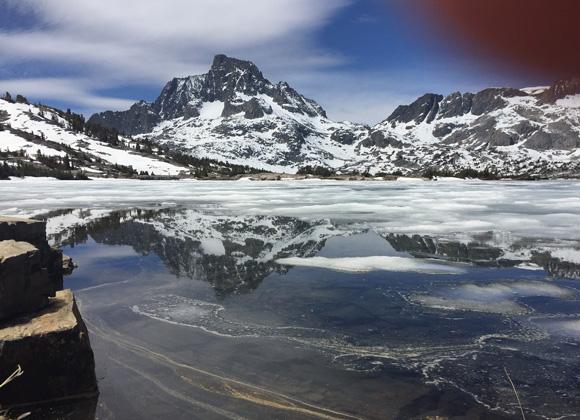
High on the Wheeler Crest the sun lights one high peak, and only for a moment. Andrea and I both catch it gleaming in our cameras. What do I think of? A mountain peak, an actual mountaintop of granite and then the metaphorical, the mountain so many of us—all of us?—seek to find.
Suddenly I remembered a letter to the editor of a dental publication that a young dentist wrote just a few weeks ago. He’d worked as an associate (an employee, basically) of an older dentist for several years and then had ventured out on his own, where he has now floundered for two years. He collects enough money to pay the office light, heat, rent, and salaries, but has not yet cleared enough to pay himself. “When does it get better?” he moaned. And he received advice from other readers. “Let people know you’re a dentist, carry your cards with you, wear your scrubs outside the office, to the store, to the restaurant. And sign up for every insurance plan you can find. Get more patients that way.”
Oh, God, NO! I said to nobody. Wear scrubs outside the office? Especially now, in the middle of a pandemic? Good Lord, what an awful and tasteless idea.
And sign up to be the provider of various insurance plans? Oh sure, there you go, young man. Your overhead is already 100% now let an insurance company discount your fees 30%. Great idea. That way you can go broke even faster.
Oh, how Andrea and I would love to sit down with this young man. Could we rescue him from his disaster in the making? I’d like to think we could. At least our advice would be better than what he’s received so far. But before giving advice, we’d ask questions. How exactly did he get himself into this predicament? There is a mountain top. Though mostly cloud hidden, it is in sight. I can see it. Maybe no one has reached the very top in this life. But many have climbed high on the rocky flanks. Andrea and I have been there. Can we show the way? As Browning wrote, A man’s reach should exceed his grasp, or what’s a Heaven for?
Oh, to be your own boss; it must have seemed a worthy dream to this young dentist; certainly, it seemed a worthy endeavor, but, as you may have heard, nothing is quite so easy as it looks.
And do you have your own personal mountain? Do you have it in sight?

Three days after the storm, the morning breaks clear, sunny, with bright blue sky, though still quite cold. Now we can see the full effect of the storm. A few folks are beginning to dig out, and some still need to. The thermometer on our deck reads 10 degrees Fahrenheit. We walk farther today, seven or eight miles, up high even into an area of avalanche danger. I see doorways piled high with snow and remember one time as a kid on a Wisconsin farm when we had to climb through a second story window to get outside and then grab shovels to begin clearing the snow from the farmhouse door. Not many are that deep in snow today, but not many are going to drive anywhere anytime soon. At least the roads are plowed now, though I hear you can’t drive north and access Highway 395 to Mammoth Mountain from here. Surely with another day of sunshine it can be done.
 Meanwhile, two young boys and their father have found a good slope of snow not far from their door. They have a sled. Father helps them get set and then sends them on their way. Too soon they turn the sled over and crash in heavy snow. They scramble up the slope and go again. And again. At least once they get a good run down the hill. Then I watch the younger boy crawl on all fours back up to the top while big brother carries the sled. Digging out can wait, can’t it, Dad? They seem to say.
Although freezing cold when we started this walk, a few miles from home we’re both shedding coats and gloves. My goodness, it feels downright hot! When we get home, Andrea opens a few doors. “It’s just too warm in the house,” she says. But then I go out on our back deck for a look at the thermometer. “Don’t leave the doors and windows open too long,” I call to her. “It’s twenty-eight degrees out here.”


 1. Expect Great Things: The Life and Search of Henry David Thoreau. Kevin Dann. From Amazon: “To Coincide with the bicentennial of Thoreau’s birth in 2017, this thrilling, meticulous biography by naturalist and historian Kevin Dann fills the gap in our understanding of one of modern history’s most important spiritual visionaries.”
 2. The Cake and the Rain. Jimmy Webb. I don’t have superlatives enough for The Cake and the Rain. If you think it’s sex, drugs and rock n’ roll you’re a fraction correct of course, but the book is written with the same brilliance that brought us all those wonderful Jimmy Webb songs: “Up, up and away,” recorded by the Fifth Dimension; “Wichita Lineman,” “By the Time I get to Phoenix,” “Galveston,” and many others that became hits for Glen Campbell; “All I know,” Art Garfunkel’s best solo effort; the inimitable Richard Harris version of “MacArthur Park;” and dozens of versions of “The Moon is a Harsh Mistress.”
 3. The Nature Fix: Why Nature makes us Happier, Healthier and more Creative. Florence Williams. Thoreau found inspiration in the quiet—well, relative quiet: there was that darned train that shook and ruffled the waters when it rumbled past—of Walden Pond. John Muir said, “The mountains are calling and I must go.” Beethoven loved to ramble among the rocks and trees; Wordsworth of course walked hundreds of miles through English countryside and once, having landed at Calais, walked across France all the way to the Alps. Nature was his greatest muse. Emerson famously wrote of man’s desire to understand his relationship with the infinite, of God and the Universe, and the power of nature to provide a key through direct experience of the wild.
 4. A Gentleman in Moscow. Amor Towels. The year is 1922 and the place, Moscow. Count Alexander Rostov has been placed under house arrest in the Hotel Metropol, where he already resides. Just a few years have passed since the second Bolshevik Revolution and it’s not a good time to be an aristocrat in Russia, especially one who has written a counter-revolutionary poem. If you are seen outside the hotel, you will be shot! Rostov is told. And so begins this delightfully told tale of his decades long confinement, the people, the love, the intricacies of place, the changes.
 5. The Push: A Climber’s Journey of Endurance, Risk, and Going Beyond Limits. Tommy Caldwell. This book has received tremendous critical praise and deservedly so. It culminates with Caldwell’s free climb of the Dawn Wall on Yosemite’s El Capitan, but there is so much more. You may not be a mountain climber, but certainly you have some dream that may lie seemingly beyond your grasp. Enjoy Push for the story, but take from it some inspiration for your own climb—whatever that might be. Simply the best outdoor adventure story I have read in quite some time.
 6. Forget me not: A Memoir. Jennifer Lowe-Anker. This beautiful memoir has received mixed reviews, some glowing and some bitingly negative. I may have been pre-conditioned to love it because I’ve watched the documentary Meru at least three times. It’s the only thing I’ve seen in an actual movie theater in the last 2 years (Okay; maybe I don’t get out much). In October, 1999, Alex Lowe, one of the world’s most accomplished mountain climbers, was killed in an avalanche in Tibet and his climbing partner, Conrad Anker, badly injured. This memoir by Lowe’s—and subsequently Anker’s—wife Jennifer is the story of their early adventurous years together, his death, her grief and renewal. I rank it among the best of the last year.
 7. Ordinary Grace. William Kent Krueger.
 8. The Subtle Art of not Giving a F***. Mark Manson. I am not alone in having to force myself to get passed the potty-mouth title. The title may be the only reason this book is a best-seller; there’s a certain appeal to uncensored vulgarity. Still, there is some value here.
 9. The Noticer. Andy Andrews. From Amazon.com: “Orange Beach, Alabama is a simple town filled with simple people. But like all humans…the good folks have their share of problems—marriages teetering on the brink of divorce, young adults giving up on life, business people on the verge of bankruptcy…Fortunately, when things look the darkest, a mysterious man named Jones has a miraculous way of showing up.”
 10. Happiness: Essential Mindfulness Practices. Thich Nhat Hanh. I read this book while camped under the aspens in the Glacier Lodge area of the Eastern Sierra, so it’s possible that almost any book or no book at all, just breathing in the still mountain air, could have provided a calming of body and mind. I don’t believe that this book is one to read straight through; instead I see it as a series of practices and exercises that one may pick and choose as desired. There are sections that will appeal to you and those can be chosen for their value to visit and revisit as desired. Mindfulness meditation is as ubiquitous as Starbucks these days according to one critic, but that doesn’t detract from its usefulness. I found this small text enjoyable and worthy.
 11. Walking the Himalayas. Levison Wood. I expected to thoroughly enjoy reading this account of a months-long trek through the high mountains of south Asia by one of England’s best-loved travel writers. What could there be not to like? And the answer is: Plenty. I’m actually surprised that I finished the whole thing. The book is humorless, lacking in empathy or insight; it’s a good dose of British boredom.
 11-1/2. Walden. Henry David Thoreau. We all read this in high school, didn’t we? Or at least pretended that we did. We remember an odd young man—at least we thought him young—living alone by a pond in a house he built for himself for 20 or 30 dollars and that he stayed a year or two out there by himself.